
Chapter Books for Kids Who Aren’t Choosing Books Yet
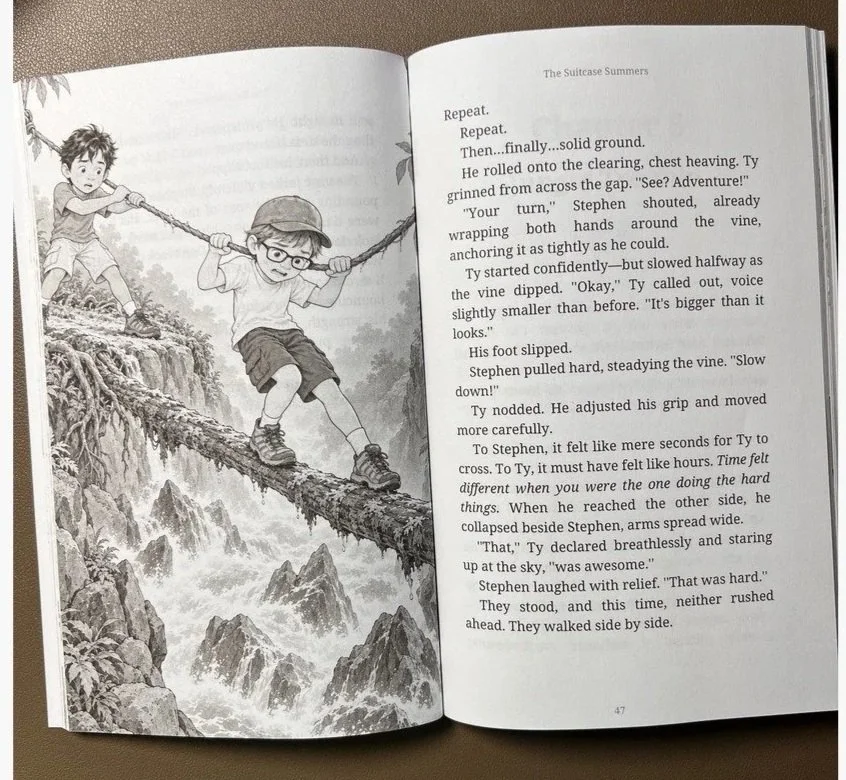
Peek inside The Suitcase Summers
“Reluctant reader” is a useful phrase for searching Google. I definitely do not love it as a label for a child.
A kid who does not voluntarily pick up a chapter book may still love stories. They may love being read to. They may memorize facts about dinosaurs, devour comics, listen to audiobooks, study maps, or spend twenty minutes examining the illustrations in a nonfiction book.
Sometimes the problem is not reading. Sometimes the problem is that the books being offered do not feel good to read.
If your child says they hate chapter books, here are a few things I would look for before deciding they simply “aren’t a reader.” Look for books that feel visually manageable
Imagine being handed a task that looks difficult before you even begin. That is what a dense page can feel like to some kids. A book with comfortable margins, visible paragraph breaks, readable type, shorter chapters, and regular illustrations may feel much more possible.
This is not about making reading “too easy.” It is about reducing the visual intimidation that can prevent a child from starting at all.
Let pictures do some of the storytelling. Illustrations can give readers clues.
A character’s face might clarify the mood of a scene. A picture can establish a setting. A small visual joke can reward a child for continuing. An illustration can help a reader remember who is who or what just happened.
Try asking your child what they learned from the picture that was not written in the text. You may discover that they are doing much more story comprehension than you realized.
Choose a strong hook over an impressive reading level
If a child has to work harder to read, the story needs to give them a reason.
Mysteries can work because there is a question to answer.
Adventure can work because something is always moving.
Humor can work because there is an immediate payoff.
Series can work because once the world and characters are familiar, the next book feels safer.
The best hook is whatever your child cares about. Let them read below their maximum ability sometimes. A child can be capable of reading a book and still not want to read it. Those are different things.
There is value in reading something that feels comfortable. Finishing a book builds momentum. Laughing while reading builds positive associations. Getting through a chapter without exhausting yourself can make the next chapter seem possible.
Not every book needs to stretch a reader. Some books can simply be enjoyable. I know I love reading for pleasure!
Try shared reading without turning it into a lesson. If your child wants the story but tires quickly, share the work.
You read a page. They read a page. You handle the long paragraph. They take the dialogue. Or simply read the entire thing aloud while they follow along. A chapter book enjoyed together still counts as a chapter book enjoyed.
You do not have to turn every family reading moment into independent-reading practice.
Pay attention to why they stopped. When a book gets abandoned, resist the urge to immediately encourage them to push through.
Ask instead:
Was it boring?
Was it confusing?
Was the print too small?
Did the chapters feel too long?
Did nothing happen quickly enough?
Did they lose track of the characters?
Would they rather hear it read aloud?
The answer can help you choose the next book much better than a reading-level number alone.
Let the child have veto power
One of the simplest ways to encourage reading is also one of the hardest for adults:
Let kids dislike books.
They do not have to finish everything.
They can return a library book after two chapters. They can say a popular series is boring. They can choose the funny book instead of the educational one.
Choice creates ownership. And ownership is much closer to the reading habit we actually want.
If illustrations help, choose illustrations
There is no reason to remove a support simply because a child is getting older.
Some readers will naturally move toward text-heavy novels. Others will continue loving illustrated books, comics, graphic novels, maps, diagrams, and visually rich nonfiction.
The goal is not fewer pictures. The goal is more reading.
A DoodlePie note
When I created The Suitcase Summers, I wanted it to feel like a real chapter-book adventure without making the pages feel cold or intimidating.
The illustrations are there because they belong in the world — and because growing readers deserve books that take them seriously while still inviting them in.
If you have a child who loves adventure but is hesitant about chapter books, you can take a look inside before deciding whether it feels like a fit.
